Showing posts with label the 30s. Show all posts

Tuesday, July 31, 2012

Everybody Sing(1938).


Everybody Sing(1938). A musical comedy film starring Judy Garland, Allan Jones, Fanny Brice, Reginald Owen and Billie Burke.

Judy Bellaire, must go home and face her family after being expelled from, Colvin School for Girls for turning her classical music into jazz . Her eccentric father Hillary and mother Diana are too busy with their own lives to deal with her problems. The family servants, Olga Chekaloff and Ricky Saboni and her sister Sylvia, are the only ones who seem to understand.

When backer John Fleming, decides that he won't finance the play, Judy thinks that she can save the play by performing herself. Judy, is sent off to Europe to prevent her from taking a job singing at the Cafe Neppo, but... she sneaks away and becomes a huge success on her own.

Wanting to help his friends the Bellaires, Ricky talks his boss at the Cafe, Signor Giovanni Vittorino, into backing a show starring himself and Judy.

Meanwhile,  Jerrold has threatened to quit Hillary's play and Sylvia promises to marry him. Heartbroken, she sends Olga out with a message for Ricky, but... Olga forgets all about it, when she is given a part in the show.

A child welfare agent, tries to stop Judy from performing in the play because she is under age, but... Olga has the man arrested as a kidnapper. Realizing that Judy is not in Europe and worried that she really has been kidnapped, they go to the police station, where they learn that she is performing in a play. They go to the theater to try and stop her, but... seeing her perform, they realize that the stage is where she belongs.


 "Everybody Sing" is a delightful 1938 film filled with music. Pre-Wizard of Oz, Judy sings with her incredible voice: "Swing Mr. Mendolssohn," "Down to Melody Farm," "Swing Low, Sweet Chariot," and "Ever Since the World Began."

Brice, does a specialty number, and Jones, in his beautiful tenor, sings "The Show Must Go On," "Cosi-Cosa," and "First Thing in the Morning."


Fanny Brice (October 29, 1891 – May 29, 1951) was a popular comedian, singer, theatre and film actress, who made many stage, radio and film appearances and is known as the creator and star of the top-rated radio comedy series, The Baby Snooks Show. Thirteen years after her death, she was portrayed on the Broadway stage by Barbra Streisand in the musical Funny Girl (1968).


Thursday, May 17, 2012

They Shall Have Music (1939).


They Shall Have Music(1939). A musical film starring violinist Jascha Heifetz (as himself), Joel McCrea, Andrea Leeds and Gene Reynolds.

The story begins when a boy from the slums named Frankie,  life is changed when hears a performance by violinist Jascha Heifetz.

Inspired by the maestro, Frankie goes back to playing his violin, that his late father had taught him to play.

After his stepfather smashes the violin he threatens to send Frankie  to reform school, Frankie runs away from home and joins up with a music school for underprivileged children run by Professor Lawson and his daughter Ann. Impressed by Frankie's talent, the professor takes him in.

Unknown to the Professor, the school  is threatened by Flower, who insists that the school charge tuition or will be shut it down. When Frankie overhears Ann and Peter McCarthy, discussing the schools financial problems, he and the other children perform on the street.

After hearing the children play, Heifetz shows an interest in the school and Peter, tells them that Heifetz will perform at the children's concert. On the evening of the performance, Flower learns that Peter was lying and sends his men to repossess the instruments.  Will Peter and Frankie find Heifetz, in time to perform with the children and save the school?


Fun Fact: One of the few films in which conductor Alfred Newman actually makes an on-screen appearance.

This film is truly a heart warming, story about poor but musically gifted children fighting to keep their music school open. Gene Reynolds, plays the young boy who's transformed by his love for the violin at a school which becomes the first real family. The performances by the musically gifted children and Heifetz are amazing. The cast including Joel McCrea, Andea Leeds and Walter Brennan make this film a true a treasure.

Full length movie:
Heifetz and his family left Russia in 1917, traveling by rail to the Russian far east and thence by ship to the United States, arriving in San Francisco. On October 27, 1917, Heifetz played for the first time in the United States, at Carnegie Hall in New York, and became an immediate sensation. Fellow violinist Mischa Elman in the audience asked "Do you think it's hot in here?", where the pianist Leopold Godowsky, in the next seat, replied, "Not for pianists." In 1917, Heifetz was elected as an honorary member of Phi Mu Alpha Sinfonia, the national fraternity for men in music, by the fraternity's Alpha chapter at the New England Conservatory of Music in Boston. As he was aged 16 at the time, he was the youngest person ever allowed in the organization. Heifetz remained in the country and became an American citizen in 1925. When he told Groucho Marx he had been earning his living as a musician since the age of seven, Groucho answered, "And I suppose before that you were just a bum.

 Heifetz performed in the movie, They Shall Have Music (1939) directed by Archie Mayo and written by John Howard Lawson and Irmgard von Cube. He played himself, stepping in to save a music school for poor children from foreclosure. He later appeared in the 1947 film, Carnegie Hall, performing an abridged version of the first movement of Tchaikovsky's violin concerto, with the orchestra led by Fritz Reiner, and consoling the star of the picture, who had watched his performance. Heifetz later recorded the complete Tchaikovsky concerto with Reiner and the Chicago Symphony Orchestra as one of RCA Victor's "Living Stereo" discs. In 1951, he appeared in the film Of Men and Music. In 1962. he appeared in a televised series of his master classes, and, in 1971, Heifetz on Television aired, an hour-long color special that featured the violinist performing a series of short works, the "Scottish Fantasy" by Max Bruch, and the Chaconne from the Partita No. 2 by Bach. Heifetz even conducted the orchestra, as the surviving video recording documents. The most recent film featuring Heifetz, Jascha Heifetz: God's Fiddler, premiered on April 16, 2011 at the Colburn School of Music. It is "The only film biography of the world's most renowned violinist, featuring family home movies in Los Angeles and all over the world "


Sunday, December 11, 2011

Fashions of 1934(1934).


Fashions of 1934(1934). Pre-Code/musical/comedy directed by William Dieterle with musical numbers created and directed by Busby Berkeley. Based on the story The Fashion Plate by Harry Collins and Warren Duff. Cast: William Powell and Bette Davis.

Sherwood Nash's, New York investment business hits hard times until he meets dress designer Lynn Mason. They quickly come up with a plan to earn a living making knock offs of beautiful Paris designs.

They learn by accident that Oscar Baroque, gets his ideas from old costume designs. Lynn, picks up on the idea and she and Sherwood sells her designs to their New York customers.

Sherwood, comes up with a new scam and becomes partners with Joe Ward, an ostrich feather salesman after he recognizes the Grand Duchess Alix, his old friend, Mabel. Threatening to expose who she really is, Sherwood suggests that she convince Baroque, to back and design the costumes of the musical in which she is performing. Wanting to please the Grand Duchess, Baroque buys Ward's entire supply of ostrich feathers. Lynn, who has grown very tired of his scams, thinks about leaving him for the piano player.

Sherwood opens a new fashion house called, Maison Elegance and Lynn's designs are very popular, until Baroque finds out about their scam. The police give him one afternoon to straighten everything out. Will he be successful or ruin everyones lives?


William Powell, is one of those witty con artiest that you can not help fall in love and root for. You will not be able to take your eyes off the very talented Bette Davis and her glamorous blonde hair. If you enjoy fashions from the 30s. This film is for you.

One of the main reasons why I wanted to watch this film, was for the production number created by Busby Berkeley. Meant to showcase 'Spin A Little Web Of Dreams' with Busby's trademark identical blonde showgirls performing complicated dance numbers.


Verree Teasdale (March 15, 1903 – February 17, 1987). Trained as a stage actress at the New York School of Expression. She first appeared on Broadway in 1924 and performed there regularly until 1932. After co-starring in Somerset Maugham's play The Constant Wife with Ethel Barrymore in 1926-27, she was offered a film contract, and her first film, Syncopation(1929). Teasdale appeared older than her physical age, which enabled her to play bored society wives, scheming other women and second leads in comedies such as, Roman Scandals (1933).

In 1935 she married actor Adolphe Menjou, and they remained together until his death in 1963. Teasdale and Menjou  performed together in two films,  The Milky Way(1936) and Turnabout (1940), and were also co-hosts of a syndicated radio program in the late 1940s and early 1950s.

Teasdale retired after the radio program finished its run, keeping busy with her hobby of costume design.

Wednesday, November 30, 2011

Garden of the Moon(1938).


Garden of the Moon (1938). Director: Busby Berkeley. Cast: Pat O'Brien, Margaret Lindsay and John Payne.

When Rudy Vallee, can not perform at the Garden of the Moon nightclub, owner John Quinn hires the young struggling band leader, Don Vincente. Don and his band fly out to California from New York, but Don is not too happy when he learns that they will be performing with a woman singer. He believes that they will only cause problems between the band members. Quinn, insists that Don use her in the band. Don surrounds her with horns so that she can not be heard. Which angers Quinn, who turns off Don's microphone so Don has to sing without it.

Thinking that they are being swindled, Toni goes looking for a new sponsor and convinces a chewing gum manufacturer to listen to Don's broadcast. When Quinn hears about their plans, he fires Don.

Knowing that Quinn is a fan of royalty, Toni plants a story about Don's friendship with the Maharajah of Sund. It's not long before Don is back at work. Quinn throws a party for the Maharajah and things are going as planned until Maurice, the materde, almost ruins them when he recognizes the Maharajah as a waiter who once worked for him.

Quinn, eventually learns the truth, but Toni convinces him not to take revenge on Don. Don has been so popular that the owners of the hotel want him to sign a contract. Which Don refuses to sign, because the gum manufacturer has offered him a radio program.

Toni, convinces Don to do the radio broadcast from Hollywood. Mistakenly, he believes that Toni is in with Quinn and quits. Quinn, has gossip columnist Jimmie Fidler, warn Quinn over the radio that gangsters are out to kill him. Quinn fakes a shooting and begs Don to stay. His plan works and soon Quinn is back to work, with Don as his bandleader.

Fun Fact:

The roles played by John Payne and Margaret Lindsay were originally intended for Dick Powell and Bette Davis. Powell took a layoff rather than make this film.


This is a fun story and the film has a lot of big band era music with some swing numbers mixed in. Payne looks and sounds great and is supported by a wonderful actress, Margaret Lindsay. The musical number, "Girlfriend of the Whirling Dervish," better known today thanks to a Looney Tunes cartoon, made its debut in this film.

Margaret Lindsay (September 19, 1910 - May 9, 1981). She is best known for her supporting work in films of the 1930s and 1940s such as: Jezebel (1938) and Scarlet Street (1945). She had leading roles in "B" films such as: Ellery Queen series in the early 1940s. Critics say her standout performance, was as Hepzibah Pyncheon in the film, The House of the Seven Gables(1940).

Wednesday, November 23, 2011

The Ice Follies of 1939(1939).


The Ice Follies of 1939(1939). Directed by Reinhold Schünzel. Cast: Joan Crawford, James Stewart, Lew Ayres and Lewis Stone. Featuring The International Ice Follies.


The story begins, when skaters Larry Hall and Eddie Burgess, meet Mary McKay, a very poor skater. Larry, insists on including in her in their act, even after being fired from all their shows.

After the couple are married, Mary, realizes that she is damaging her husband's career and convinces the head of Monarch Studios, to hire her. Mary, soon discovers that she can not marry without the permission of the studio and Larry tells her to keep their marriage a secret.

After his wife becomes a huge star, Larry leaves for New York, to meet with his former partner Eddie, in the office of producer Mort Hodges, who plans to help Larry with his dream of producing the Ice Follies.

After, Larry's Ice Follies, becomes a huge hit, Mary wants to give up her career to save their marriage. Will she change her mind after the the two are hired to work on the same show?


The best part of this movie is the ice-skating scenes. Joan Crawford, got a chance to play a much softer character. If you are like me, you will want to watch any movie with Jimmy Stewart in it..

Lew Ayres (born Lewis Frederick Ayres III; December 28, 1908 – December 30, 1996). He was discovered playing banjo in the Henry Halstead Orchestra as Halstead was recording one of the Vitaphone movie shorts called, Carnival Night in Paris(1927).

Ayres played opposite Greta Garbo in the film ayres,, The Kiss(1929), but it was his starring role in the film, All Quiet on the Western Front(1930), which made him a star. Ayres was Janet Gaynor's leading man in, Servants' Entrance (1934). He played the title role in, Young Dr. Kildare (1938) and starred in several Kildare films. During this time, Ayres also co-starred with Joan Crawford and James Stewart in the film, The Ice Follies of 1939.

Ayres made few films after the war, but in 1948 his role in, Johnny Belinda earned him an Academy Award nomination for Best Actor.

Sunday, November 6, 2011

Stage Struck (1936).


Stage Struck (1936). Cast: Dick Powell and Joan Blondell and Jeanne Madden. Director: Busby Berkeley.

Dance director George Randall, is not too happy and leaves the show when the star of the show is replaced by Peggy Revere, a woman whose only claim to fame is that she shot her husband. Now, that he is free..  Producer Fred Harris, hires him for his new show. What George doesn't know, is that Peggy, is backing and starring in the show. When, she learns that George, has been hired she tears up his contract. Fred, decides to use reverse psychology on Peggy and convinces her that hatred is really a sign of love.

George, is in love with Ruth Williams, who wants a job in show business. George, tries to talk Ruth out of it. Actor Gilmore Frost, helps Ruth get the job. When, Ruth sees George, singing a love song to Peggy, she thinks he is in love with her. The show is a failure, because Peggy is not very talented. Frost, hits her and George, insists that she go to the hospital. Ruth, plans to go on stage and in the last minute, Peggy insists she is well enough to perform. The police arrest both her and Frost for assault. George, asks Ruth to marry him.


Fun Fact:

The movie box office got a big boost when Dick Powell and Joan Blondell were married shortly before its release.


Stage Struck, is one of the least known of Busby Berkeley's Warner Bros. musicals, because there are no major production numbers.  Although, There are some wonderful songs by Harold Arlen and E.Y. Harburg :"Lady of the Moon" (sung by chorus girls during rehearsals, with Frank McHugh); "Fancy Meeting You" (sung by Dick Powell and Jeanne Madden); "In YOUR Own Quiet Way" (sung by Powell) and "In HIS Own Quiet Way" (a try-out, sung by Jeanne Madden). The film's highlight is the musical number by the Yacht Club Boys. Also featured in the cast are: Spring Byington and Carol Hughes, Hobart Cavanaugh,a young Jane Wyman and Jeanne Madden, in her movie debut.

Wednesday, August 24, 2011

Footlight Parade(1933).


Footlight Parade(1933). Musical film starring James Cagney, Joan Blondell, Ruby Keeler and Dick Powell and featuring Frank McHugh, Guy Kibbee, Hugh Herbert and Ruth Donnelly. The movie was written by Manuel Seff and James Seymour from a story by Robert Lord and Peter Milne. It was directed by Lloyd Bacon.

The spectacular Busby Berkeley musical numbers, written by Harry Warren (music) and Al Dubin (lyrics) and Sammy Fain (music) and Irving Kahal (lyrics), include "By a Waterfall", "Honeymoon Hotel", and "Shanghai Lil".

Musical Producer Chester Kent, finds himself out of work because of the popularity of talking pictures. His wife leaves him when he tell her the news. He convinces his two partners, Sy Gould and Frazer, to help him in producing, live performances to be performed before the movies are shown.

As soon as Chester thinks up ideas, Gladstone, is always one step ahead of him. Also, his partners are cheating him out of his share of the profits. His only friend seems to be his secretary, Nan Prescott, who is in love with him. But, he is in love with Vivian Rich, a gold digging actress. The theater owner Appolinaris, promises that if Chester can come up with three new shows in three days, he will hire him.

Chester, locks everyone in the studio to prevent any leaks. The first two shows are a big success. Then at the last minute, Chester has to go on as the lead in the last one because the star is drunk. He performs well and lands the contract.

Fun Fact:

Film debut of Dorothy Lamour.


Footlight Parade, showcases Busby Berkeley's extravaganzas, that are so creative and fun to watch. Also, James Cagney, shows his versatility as a dancer as well as a tough guy. Dick Powell, sing three songs in Footlight Parade, Ah the Moon is Here, Honeymoon Hotel and By a Waterfall, the last two with Ruby Keeler. Ruby, also partners with James Cagney in, Shanghai Lil. One of Blondell's best screen roles. Also, look for Dorothy Lamour and Ann Sothern in the chorus. John Garfield, is also seen very briefly in the Shanghai Lil number.


Ruth Donnelly (May 17, 1896 – November 17, 1982), began her stage career at the age of 17 in 1913, in The Quaker Girl. Her Broadway debut brought her to the attention of George M. Cohan, who cast her in many comic-relief roles in musicals. Though she made her first film performance in 1913, her Hollywood career began in 1931-1957.

Colleen(1936).


Colleen(1936). Musical film directed by Alfred E. Green. Cast: Dick Powell, Ruby Keeler, and Joan Blondell.

To the dismay of his family, the eccentric millionaire Cedric Ames, is talked into by his new assistant Joe Cork, to buy a dress shop for gold digger Minnie Hawkins, a former candy dipper at the "Itsey-Ditsey Nut Chewsie". Cedric's nephew, Donald Ames, steps in to close the dress shop.

The dress shops book-keeper Colleen Reilly, does not want Donald to close the dress shop, especially now, when the dress shop is doing so well.. Colleen, plans a fashion show and even designs some of the dresses herself. Now, all she has to do, is to talk Donald into keeping the shop open.

When Donald, asks her to dinner to discuss the dress shop, she agrees and that is when she tells him that she is engaged to Joe.


Joe and Minnie come up with a plan to get Cedric to adopt Minnie, after which Joe will marry her. Cedric's wife Alicia forces Donald to close the shop, to put a stop to their plans.

Meanwhile, Donald and Colleen have fallen in love. After, Minnie, Joe and Colleen are all fired. Colleen, thinks that Donald has been lying to her, so when he phones to ask her to marry him, she hangs up on him. Brokenhearted, she decides to open a dress shop on board an ocean liner. The ship turns out to be the one which Donald is on. But further complications follow before things get under way on board the ocean liner.


This film reunites the musical team of Dick Powell and Ruby Keeler for the seventh and final time. A fluffy little comedy that somehow works, with plenty of songs and dance. Colleen, an overlooked musical, giving Keeler an opportunity to sing and dance more than she ever did on screen . However, her dancing with Draper, is no threat to Astaire and Rogers.Colleen, is worth viewing at least once.


Louise Fazenda (June 17, 1895 - April 17, 1962), performed mostly in silent comedy films. Before trying motion pictures, she worked for a dentist, a candy store owner, and a tax collector and on stage.

Fazenda got her start in comedy shorts as early as 1913 with Joker Studios, frequently appearing with Max Asher and Bobby Vernon. She was soon recruited for Mack Sennett's troupe at Keystone Studios.

Fazenda continued through the 1930s, performing mostly in character roles. She played such diverse parts as a fussy old maid and a lady blacksmith.


Friday, July 22, 2011

Old Man Rhythm(1935).


Old Man Rhythm(1935). Directed by Edward Ludwig. Cast: Charles Rogers, George Barbier, Barbara Kent, Grace Bradley and Betty Grable.

When John Roberts, Sr., one of the owners of the Roberts Doll Company, hears that his son Johnny is spending more time on co-ed Marion Beecher than on his studies or on his childhood sweetheart, Edith Warren, he leaves for Fairfield College to visit his son. After finding out that Johnny is love with Marion, Mr. Roberts decides to enroll in the school as a freshman and keep an eye on his son. He soon becomes the most popular student at Fairfield, Mr. Roberts makes Pinky Parker, Paul's shy son, his partner in crime. Mr. Roberts writes a letter to Paul asking him to write back and pretend that the toy business is bankrupt, in hopes of getting rid of Marion. The letter, some how is never sent. Because of Mr. Robert's antics, the business really begins to fail. Marion, gets into a argument with Johnny over Edith, which causes Johnny to want to get married after the prom. At the dance, Paul and Rochet, arrive to inform them about the financial troubles of the toy company in front of Marion. As predicted, Marion breaks it off with Johnny, who, returns to Edith, now his father can go back home to save his company.

The plot and the songs are ok, but.. there are some fun things about the film. First, there's  Betty Grable, who is featured in many songs and she does a tap dance on her toes, ballet style. Next, there's "Blimp," played Sonny Lamont, who does a wonderful dance number . I also enjoyed seeing, Johnny Mercer, in the first of his two acting roles. Finally, it was fun to spot Lucille Ball, in an early uncredited nonspeaking part. Don't blink you may miss seeing her.


Barbara Kent (born December 16, 1906) is a Canadian-born silent film actress. Following the death of Miriam Seegar, she is believed to be the only living American actor to have achieved substantial fame during the silent era as an adult.

She began her Hollywood career in 1925. A brunette who stood less than five feet tall, Kent made a strong impression as the heroine pitted against Greta Garbo's femme fatale in the film, Flesh and the Devil (1926).

She received attention for the film, No Man's Law(1927) by swimming nude; she wore a flesh colored bathing suit in scenes .  She made the transition into talking pictures opposite Harold Lloyd in the comedy, Welcome Danger (1929). She also received praise for her role in the film version of, Oliver Twist(1933).

In 1934 she married agent and producer Harry E. Edington and took a one-year hiatus. Edington groomed Kent for what he intended to be a high-profile career. However by the time she returned to films, her popularity had faded and she was unable to establish herself again. She made her final film in 1935.

Friday, March 18, 2011

In Caliente(1935)


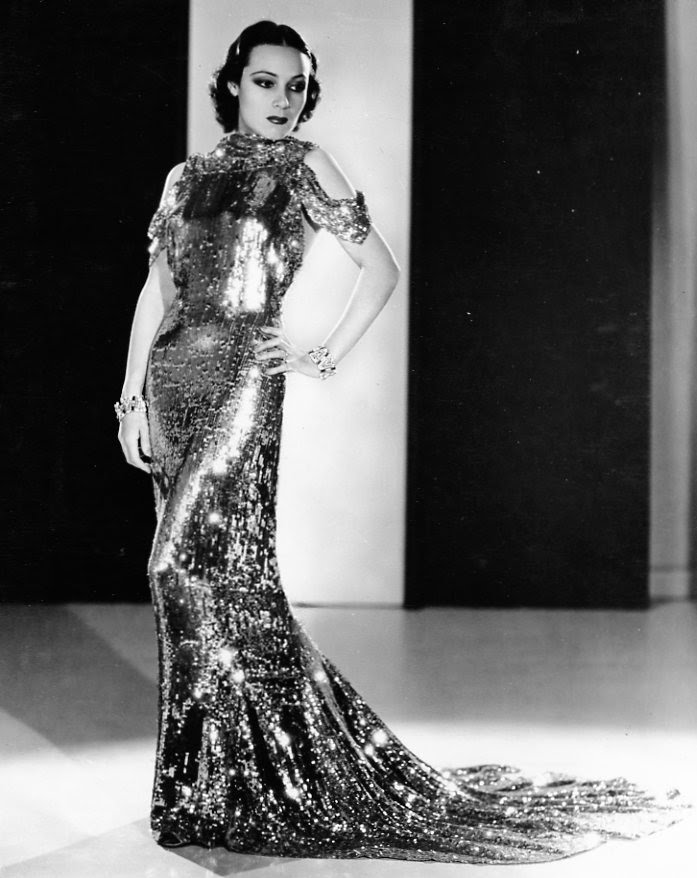
In Caliente(1935), also known as Viva Señorita, is a film written by Ralph Block, directed by Lloyd Bacon, and starred Dolores del Río.

IN CALIENTE (1935), the story takes place in the popular Mexican resort, best known for horse racing and gambling. It stars Dolores Del Rio, in a fluffy story and wonderful choreography by, Busby Berkeley. Berkeley focuses on ballroom dancing popularized by Fred Astaire and Ginger Rogers.

The story begins when Larry MacArthur, critic of New York City's smartest magazine, Manhattan Madness, who is well known for writing bad reviews. Harold Brandon, vice president, wants to break up Larry's engagement to gold digger, Clara Thorne. Knowing the upcoming marriage will be a mistake, Harold gets Larry drunk and kidnaps him by airplane to Aqua Caliente, a Mexican resort. While there, he meets Rita Gomez, who he does not know that she is a dancer, that he criticized in his magazine. Recognizing Larry as the man who had given her a bad review, Rita wants to get even with him, with the help of Jose Gomez, her uncle. The situation becomes more complicated when Clara shows up to claim her man.

This very entertaining movie showcases Dolores Del Rio, Pat O'Brien and Edward Everett Horton. Another plus.. is the location filming at Agua Caliente. Chris Pin-Martin, as one of the mariachis, has the wonderful line, "English not so very good looking."

Fun Facts:

The costumes in "The Lady in Red" number were actually blue, but looked "red" when photographed in black and white.


Soundtracks:


•"In Caliente"
(uncredited)
Music by Allie Wrubel
Lyrics by Mort Dixon
Played during the opening credits
Played as background music
Played on guitar and sung often by the mariachis
(Chris-Pin Martin, C.R. Dufau, L.R. Félix and Carlos Salazar)

•"When Irish Eyes Are Smiling"
(uncredited)
Music by Ernest Ball (1912)
Lyrics by Chauncey Olcott and George Graff (1912)
Sung a cappella by Phil Regan, Pat O'Brien and Edward Everett Horton

•"To Call You My Own"
(uncredited)
Music by Allie Wrubel
Lyrics by Mort Dixon
Sung by Phil Regan
Played as background music
Whistled and hummed by Pat O'Brien


•"The Lady in Red"
(uncredited)
Music by Allie Wrubel
Lyrics by Mort Dixon
Sung by Wini Shaw, Judy Canova and chorus
Danced by The De Marco's
Sung a cappella by Edward Everett Horton

•"Muchacha"
(uncredited)
Music by Harry Warren
Lyrics by Al Dubin
Sung by Phil Regan
Sung and Danced to by Dolores del Rio and chorus

•"She's a Latin from Manhattan"
(uncredited)
Music by Harry Warren
Used as background instrumental

•"Tango Muchacha"
(uncredited)
Music by Harry Warren
Used as background instrumental


Monday, February 28, 2011

Broadway Melody (1936)


Broadway Melody (1936). It was a follow up to the film, The Broadway Melody(1929). Beyond the title and some of the music, there is no story connection with the earlier film. The film was written by Harry W. Conn, Moss Hart, Jack McGowan and Sid Silvers. Directed by Roy Del Ruth. Cast: Jack Benny, Eleanor Powell, Una Merkel and Robert Taylor. It was nominated for the Academy Award for Best Picture.

The story begins when, columnist Bert Keeler, is told by his editor that he has to stop writing about "Blessed Events" and start digging up dirt. Lillian Brent, who is backing Gordons new show also wants to be star of the show and Keeler, thinks their story is what his editor is looking for.

Bob's childhood sweetheart, Irene Foster, comes to his office, but he doesn't recognize her at first. Shortly after she leaves, he finds the fraternity pin that he once had given her, he tells his secretary, Kitty Corbett, to find her. When she auditions for his show, he tells her that Broadway isn't for her. She dreams in a beautiful dance number of being a hit in his show. Bob, buys her ticket to go back home.


Lillian, talks Bob into agreeing that if he doesn't find a star for the show within two weeks, she can play the lead.

Keeler, has been spreading rumors about a French musical star named Mlle. La Belle Arlette and when Kitty finds out the truth, she helps Irene assume that identity.


Just as Irene's dreams are about to come true, Keeler tell her that he knows that she is an impostor and threatens to sue the paper if she continues with the lie. Will she be able to talk him out of suing and will Bob ever find out the truth about Irene's identity ?


In this wonderful musical-comedy, Una Merkel and Sid Silvers (who has one hilarious scene disguised as Mademoiselle Arlette) make a wonderful pair who have many, very cute scenes. In 1936, Powell, Merkel, Buddy Ebsen, Langford and Silvers would be joined together for the film, BORN TO DANCE.


Fun Facts:

This was Powell's first leading role, and her first movie for MGM. She would appear in the next two films in the Broadway Melody series: Broadway Melody (1938) and Broadway Melody (1940). This was also Ebsen's film debut.

Reportedly, Eleanor Powell did not want to be in this film but was too polite to directly tell MGM executives. She asked for the leading role and an exorbitant salary, and MGM accepted her demands.

The singing voice of Eleanor Powell was dubbed by Marjorie Lane.

Preceded by The Broadway Melody (1929) and followed by Broadway Melody of 1938 (1937) and Broadway Melody of 1940 (1940). Another film in the series was planned, "Broadway Melody of 1943" starring Eleanor Powell and Gene Kelly. However, that project was abandoned, and a dance number filmed by Eleanor Powell was edited into, Thousands Cheer (1943).


Una Merkel (December 10, 1903 – January 2, 1986) , looked a lot like actress Lillian Gish and began her career as a stand-in for Gish, in the classic silent film, The Wind(1928). Merkel, also performed in the silent the film, Love's Old Sweet Song (1923).

She played Ann Rutledge in the film, Abraham Lincoln (1930. During the 1930s, Merkel became a popular second lead, playing the wisecracking best friend of the heroine. Merkel was an MGM contract player from 1932 to 1938, performing in as many as twelve films in a year, often on loan-out to other studios.

In 42nd Street (1933), Merkel played a streetwise showgirl. Merkel performed in both the 1934 and the 1952 film versions of, The Merry Widow. One of her most famous roles was in the Western, Destry Rides Again (1939) in which her character, Lillibelle, gets into a famous "cat-fight" with Frenchie (Marlene Dietrich). She played the elder daughter to the W. C. Fields character, in the film, The Bank Dick(1940).

She had a major part in the film, The Mating Game(1959) as Paul Douglas's wife and Debbie Reynolds's mother, and was nominated for an Academy Award for Best Supporting Actress in the film, Summer and Smoke (1961). Merkel, whose final film role was in the Elvis Presley film Spinout (1966).


June Knight (January 22, 1913 – June 16, 1987) . At the aged of 19, she performed in the last Ziegfeld Follies show, Hot-Cha! (1932). She also performed in the film, Broadway Melody (1936), in which she sang a duet with actor Robert Taylor. She performed in movies from 1930 to 1940.


Vilma Ebsen (February 1, 1911 – March 12, 2007) , best known for dancing in MGM musicals in the 1930s with her famous brother, Buddy Ebsen. She learned to dance at her father's dance studio in Orlando, Florida, in the 1920s. Vilma and Buddy Ebsen moved to New York in 1928, where they formed a vaudeville act. One of their first appearances together was in Eddie Cantor's Ziegfeld production, Whoopee. When Whoopee closed after a year and a half, Vilma and Buddy Ebsen took their act to Atlantic City, where they caught the eye of celebrity columnist Walter Winchell, who help them with their career.

Vilma and Buddy Ebsen performed their dance act on Broadway, as well as around the United States in vaudeville theatres and supper clubs throughout the early 1930s. Some of the Broadway productions they starred in were Flying Colors (1932) and Ziegfeld Follies of 1934. They came to Hollywood in 1935, where Vilma Ebsen starred in one film, Broadway Melody of (1936).

After the film, Broadway Melody (1936), the studio decided to separate the Ebsens. Vilma Ebsen was not interested in accepting Louis B. Mayer's offer to make her "the next Myrna Loy" and moved back to New York with her husband, composer and bandleader Robert Emmett "Bobby" Dolan. Later, she opened a dance school in Pacific Palisades with her sister, Helga, partially funded by their brother.

Harry Stockwell (April 27, 1902 – July 19, 1984), made his film debut in the film, Strike Up the Band (1935). Although, he is best known as the voice of "The Prince", in Walt Disney's animated classic, Snow White and the Seven Dwarfs (1937).

Harry Stockwell was married to actress Nina Olivette, and was the father of actors Dean Stockwell and Guy Stockwell.


Soundtracks:

"Broadway Rhythm"
(1935)
Music by Nacio Herb Brown
Lyrics by Arthur Freed
Played during the opening credits
Danced to by a chorus at rehearsal
Sung by Frances Langford at the nightclub
Danced to by Buddy Ebsen, Vilma Ebsen, June Knight, Nick Long Jr. and Eleanor Powell at the nightclub

"You Are My Lucky Star"
(1935)
Music by Nacio Herb Brown
Lyrics by Arthur Freed
Played during the opening credits
Sung by Frances Langford and chorus
Sung and danced to by Eleanor Powell (dubbed by Marjorie Lane) and chorus in a ballet
Played on piano by Roger Edens and danced to by Eleanor Powell
Reprised by Robert Taylor and chorus at the end
Played as background music often

"Broadway Melody"
(1929)
Music by Nacio Herb Brown
Lyrics by Arthur Freed
Sung by Harry Stockwell in the first scene

"I've Got a Feelin' You're Foolin'"
(1935)
Music by Nacio Herb Brown
Lyrics by Arthur Freed
Sung by June Knight, Robert Taylor and chorus
Danced to by June Knight, Nick Long Jr. and chorus
Reprised by Frances Langford
Played as dance music and during end credits

"Sing Before Breakfast"
(1935)
Music by Nacio Herb Brown
Lyrics by Arthur Freed
Sung and danced to by Buddy Ebsen, Vilma Ebsen and Eleanor Powell
(dubbed by Marjorie Lane)

"All I Do Is Dream Of You"
(1934)
Music by Nacio Herb Brown
Lyrics by Arthur Freed
Sung on a record in French by an unidentified singer

"On a Sunday Afternoon"
(1935)
Music by Nacio Herb Brown
Lyrics by Arthur Freed
Sung and danced to by Buddy Ebsen and Vilma Ebsen

"The Old Folks at Home (Swanee River)"
(1851)
Written by Stephen Foster
Performed by Roger Edens


Wednesday, February 2, 2011

The Great Waltz (1938).


The Great Waltz (1938). Biographical film based loosely on the life of, Johann Strauss II. Cast: Luise Rainer, Fernand Gravet and Miliza Korjus. It was the only starring role for Korjus, who was a famous opera soprano and played one in the film.

Joseph Ruttenberg won the Academy Award for Best Cinematography. Korjus was nominated for Supporting Actress and Tom Held for Film Editing.

While Johann Strauss, the son of the well-known waltz composer, is working at his job in a bank,  he is caught working on his music and is fired.  He is in love with Poldi Vogelhuber, the daughter of baker Kienzl, who has an employee, who is also a amateur musician, suggests that they start an orchestra of their own. A short time later, they get a job at the Donmayer's Cafe, but their music does not seem to interest Otto's customers, but.. his music brings in everyone from miles around to listen to him perform. Just as Johann leaving, Fritz Schiller and Carla Donner, two stars from the Imperial Opera, arrive at the cafe and ask to have the orchestra play for them. Johann plays a new waltz, "Artist's Life". Schiller, is impressed with Johann and arranges for him to attend a party at the palace of Count Hohenfried. Carla sings one of Johann's waltzes, which attracts the attention of the music publisher Julius Hofbauer, but Johann is insulted because he does not think they take him seriously. He storms out of the party and marries, Poldi. A short time later, a revolution breaks out and Johann writes a march that becomes the anthem of the revolutionaries. One day, as marchers start to sing the song in the streets, they surround the coach of an aristocrat. Just as violence is about to break out, Johann sees Carla is in the coach and comes to her rescue. They then drive through the Vienna Woods and Johann is inspired by the sounds of the forest to compose a song, which he and Carla  sing. They are then caught in a rainstorm and take cover at a small inn where the innkeeper, who thinks that Carla is Johann's wife tells her "it must be wonderful to be the wife of Johann Strauss." After she agrees, Johann leads the inn's small orchestra in one of his compositions and he and Carla realize that they are in love.

As Johann and Carla were about to board the ship traveling to Budapest, he finds that he can not leave behind, his wife Poldi. Will he say goodbye to Carla?


THE GREAT WALTZ is a wonderful musical with, beautiful, cinematography. Luise Rainer at her best and Miliza Korjus was wonderful in their performance . The plot wonderfully mixes music and sentiment together.


Fernand Gravey (December 25, 1905 November 2, 1970), was the son of actors Georges Mertens and Fernande Depernay, who performed in silent films.

He started performing at the age of five, under his father's direction.  He received his education in Britain, so could speak both French and English. Which would become useful in his later movie roles.

He had made four silent films in 1913 and 1914, but his first film of any importance was, L'Amour Chante in 1930. In 1933, he made his first English language film, Bitter Sweet.

The first two films he made in America were, The King and the Chorus Girl (1937), his fifth film in English (opposite Joan Blondell and Jane Wyman) and Fools for Scandal (1938), opposite Carole Lombard and Ralph Bellamy. He then signed with Metro-Goldwyn-Mayer and was cast as Johann Strauss in the biopic The Great Waltz, opposite Luise Rainer and Miliza Korjus.

Among his last English language performances were, How to Steal a Million (1966), Guns for San Sebastian (1968) and The Madwoman of Chaillot (1969).

Monday, December 20, 2010

The Busby Berkeley 9- Film Collection. Gold Diggers in Paris(1938).


Gold Diggers in Paris(1938). Directed by Ray Enright with musical numbers created and directed by Busby Berkeley. Cast: Rudy Vallee, Rosemary Lane, Hugh Herbert and Allen Jenkins.

Maurice Giraud, is sent to New York to make arrangements for the Academy Ballet of America to come to Paris to compete at the international dance festival, but a cabbie takes him to the Club Balle by mistake.

The owners of the club, Terry Moore and Duke Dennis, sees the mistake as an opportunity as a way out of their financial problems. They hire ballet teacher Luis Leoni and Kay Morrow, to teach their girls ballet. Terry is attracted to Kay, but things become complicated when his ex-wife, Mona shows up.

Meanwhile, the head of the real ballet company, Padrinsky, finds out what's happened and cables Giraud, then heads to Paris with a ballet-loving gangster named Mike Coogan, who intends to rub out Terry and Duke. Giraud is upset about being hoaxe.

After they arrive in Paris, a representative of the exposition, Pierre Le Brec, wants to watch the group's rehearsals, and Duke tells his new friend Coogan, the gangster, that Le Brec is causing him trouble. Coogan goes to "take care" of the problem, but by mistake knocks out Leoni instead of Le Brec. Padrinsky shows up and arranges for the imposters to be deported on the day of the contest, but Kay manages to change the order so that Coogan and Padrinsky are shipped out instead, which allows the company to perform and win the grand prize.

GOLD DIGGERS IN Paris, seems to focuses more on singing and band playing than dancing. It also shows the changing of the times as well as the decline of the Warners musicals. Look for Eddie Anderson in a small role as a doorman and try to find Carole Landis, before she became a blonde, as one of the members of gold digging troupe.

Gold Diggers in Paris, was the fifth and last in the series of "Gold Digger" films, following Gold Diggers of Broadway (1929), which is now lost. Gold Diggers of 1933, which was a remake of the earlier film, and the first to feature Busby Berkeley's extravagant production numbers; Gold Diggers of 1935 and Gold Diggers of 1937.

The Schnickelfritz Band, a comedy musical group performs the songs in the film. Led by Freddie Fisher, who played woodwinds, sang and also composed the song "Colonel Corn" for the band, the band consisted of Stanley Fritts (trombone, drums, jug, washboard), Nels Laakso (cornet, trumpet), Paul Cooper (piano, arrangements), Kenneth Trisko (drums), and Charles Koenig (bass). The group, which was billed as "America's Most Unsophisticated Band!", were brought to Hollywood by Rudy Vallee, after his agent saw them in St. Paul, Minnesota.

The band broke up shortly after doing the film, with Fritts taking some of the members east to become the "Korn Kobblers", and Fisher staying in Hollywood to open a nightclub. The Schnickelfritz Band never appeared in another film, Fisher appeared in several others as a band leader.


Soundtracks:

"Daydreaming (All Night Long)"
Music by Harry Warren
Lyrics by Johnny Mercer
Sung by Rudy Vallee

"The Latin Quarter"
(uncredited)
Music by Harry Warren
Lyrics by Al Dubin
Performed by Rudy Vallee, Rosemary Lane, Allen Jenkins and Mabel Todd

"My Adventure"
(credit only)
Music by Harry Warren
Lyrics by Johnny Mercer
(credited on-screen but not used)

"Colonel Corn"
(uncredited)
Written by Freddie Fisher
Performed by the Schnickelfritz Band

"I Wanna Go Back to Bali"
(uncredited)
Music by Harry Warren
Lyrics by Al Dubin
Sung by Rudy Vallee and the showgirls
Played by The Schnickelfritz band

"Put That Down in Writing"
(uncredited)
Music by Harry Warren
Played when Terry walks down the corridor and encounters Mona in his room

"A Stranger in Paree"
(uncredited)
Music by Harry Warren
Lyrics by Al Dubin
Sung by Rudy Vallee and Rosemary Lane

"Listen to the Mockingbird"
(uncredited)
Music by Richard Milburn
Lyrics by Septimus Winner
Performed by the Schnickelfritz Band

Friday, December 10, 2010

From the Busby Berkeley 9-film Movie Collection: Hollywood Hotel (1937).

Hollywood Hotel(1937). Directed by Busby Berkeley.Cast: Dick Powell, Rosemary Lane, Lola Lane, and Ted Healy. Ronald Reagan, Benny Goodman and Harry James (a member of Goodman's band).


It is best remembered for the song "Hooray for Hollywood" by Johnny Mercer and Richard A. Whiting, sung in the film by Johnnie Davis and Frances Langford, accompanied by Benny Goodman and his orchestra. The song has become a standard part of the soundtrack to movie award ceremonies, including the Academy Awards.

Ronnie Bowers, a singer and saxophone player with Benny Goodman's orchestra wins a contract with All Star Pictures. They book him into the Hollywood Hotel, which is also the home of Mona Marshall. The afternoon before the premiere of her latest movie, Mona is interviewed by Louella Parsons, who breaks the news that Mona will not get the lead in a new film. Heartbroken, Mona decides not to go to the premiere and goes into hiding. Publicist Bernie Walton holds a casting call to find a woman who "looks like" Mona, to  show up at the premiere and finds Virginia Stanton, who worked as Mona's stunt double. Worried that Mona's escort, Alexander Dupre, will know the difference, they ask Ronnie to be her date. The next day, Mona returns and demands that Ronnie and Virginia be fired. Ronnie confused by Mona's behavior until Bernie tells him what is going on. Virginia gets Ronnie a job as a car hop, where director Walter Kelton overhears his singing. Kelton offers Ronnie a job dubbing Dupre's voice in the new Mona Marshall movie. After the first screening the actor is invited by Louella Parsons to sing in her program "Hollywood Hotel". He accepts, but he doesn't know that Ronny Bowers does not want to lend him his voice again.

Some of the he best moments of the film are the Goodman's numbers which include a good look at vibraphonist Lional Hampton and drummer Gene Krupa, along with jazz trumpeter Harry James.

Fun Facts:

The actual "Hollywood Hotel" on which this movie is based, was a Hollywood institution. It was a sprawling building built at the turn of the century and had formal gardens, grand lobby, 2 towers and a ballroom. It was the hangout for many stars over the years. It was finally torn down in 1956. The site today is occupied by the new Hollywood-Highland shopping complex and Kodak Theater, where the Oscars are now presented every year.

The drive-in restaurant where Dick Powell's character works is called "Callahans" in the film. The actual coffee shop in Hollywood was called "Carpenter's" and was located at the southeast corner of Sunset and Vine Streets. It was one of the earliest "drive-in" restaurants in the U.S. The uniform worn is based on the actual uniforms the mostly male waiters wore. They were based on the uniforms that service station attendants wore. The reason for this new type of restaurant was to cater to the new younger movie star who wanted to be seen in their expensive automobiles. The restaurant was open all night.

Ginger Rogers was offered a leading role in this movie, but turned it down.

Louella Parsons (August 6, 1881 – December 9, 1972) was an American gossip columnist who, for many years, was an influential arbiter of Hollywood, often feared and hated by actors, whose careers she could negatively impact via her radio show and newspaper columns.

Parsons also appeared in numerous cameo spots in movies, including Hollywood Hotel (1937), Without Reservations (1946) and Starlift (1951).


Soundtracks:

"Dark Eyes"
 (1937)


Hooray for Hollywood"
(1937)
Music by Richard A. Whiting (as Dick Whiting)
Lyrics by Johnny Mercer
Sung by Johnnie Davis and Frances Langford
Performed by Benny Goodman and His Orchestra

"California Here I Come "
(1924) (uncredited)
Music by Joseph Meyer
Performed by Benny Goodman and His Orchestra

"I'm Like a Fish out of Water"
(1937)
Music by Richard A. Whiting (as Dick Whiting)
Lyrics by Johnny Mercer
Sung by Dick Powell, Rosemary Lane

"Silhouetted in the Moonlight"
(1937)
Music by Richard A. Whiting (as Dick Whiting)
Lyrics by Johnny Mercer
Sung by Rosemary Lane
Reprised by Jerry Cooper and Frances Langford
Performed by Raymond Paige and His Orchestra

"I've Got a Heartful of Music"
(1937)
Music by Richard A. Whiting (as Dick Whiting)
Lyrics by Johnny Mercer
Performed by Benny Goodman and His Orchestra
Reprised by Benny Goodman, Lionel Hampton, Teddy Wilson and Gene Krupa

"Let That Be a Lesson to You"
(1937)
Music by Richard A. Whiting (as Dick Whiting)
Lyrics by Johnny Mercer
Sung by Johnnie Davis, Dick Powell, Rosemary Lane, Mabel Todd,
Ted Healy, Harrison Greene, Constantine Romanoff and chorus
Performed by Benny Goodman and His Orchestra

"Sing, Sing, Sing"
(1936) (uncredited)
Music by Louis Prima
Performed by Benny Goodman and His Orchestra

"I've Hitched My Wagon to a Star"
(1937)
Music by Richard A. Whiting (as Dick Whiting)
Lyrics by Johnny Mercer
Sung by Dick Powell
Performed by Raymond Paige and His Orchestra

"Ochi Tchornya (Dark Eyes) (uncredited)
Traditional Russian folk tune
Arranged by Raymond Paige
Sung by a chorus and played by Raymond Paige and His Orchestra

"Sing, You Son of a Gun"
(1937)
Music by Richard A. Whiting (as Dick Whiting)
Lyrics by Johnny Mercer
Sung by Dick Powell, Johnnie Davis, Rosemary Lane, Frances Langford,
Lola Lane, Jerry Cooper, Glenda Farrell, Ted Healy, Mabel Todd and chorus
Performed by Benny Goodman and His Orchestra and Raymond Paige and His Orchestra

"I'm a Ding Dong Daddy from Dumas"
(1928) (uncredited)
Written by Phil Baxter

"Bob White (Whatcha Gonna Swing Tonight?)"
(uncredited)
Music by Bernard Hanighen
Played after the premiere upon entering the Orchid Room

"Have You Got Any Castles, Baby?"
(1937)
Music by Richard A. Whiting (as Dick Whiting)
Played at the Orchid Room when Virginia asks Ronnie to dance

"Sonny Boy"
(1928) (uncredited)
Music by Ray Henderson
Lyrics by Al Jolson, Buddy G. DeSylva and Lew Brown
Sung by Ted Healy at the casting window

"Old Black Joe"
(1860) (uncredited)
Written by Stephen Foster
Performed by unidentified singers during the "Love & Glory" number

"Blue Moon"
(1934) (uncredited)
Music by Richard Rodgers
Performed by Raymond Paige and His Orchestra at the beginning of the radio broadcast

"You Oughta Be in Pictures"
(1934) (uncredited)
Music by Dana Suesse
Played during the radio broadcast when Louella Parsons is introduced

"Old Folks at Home (Swanee River)"
(1851) (uncredited)
Written by Stephen Foster
Played during the radio broadcast of "Love & Glory"

"Satan's Holiday"
(1934) (uncredited)
Music by Joe Venuti
Arranged by Benny Goodman